Milan’s San Satiro: how can perspective change a small space?

At Santa Maria presso San Satiro, a small shift in position can change your understanding of an entire interior. From the central approach, the space behind the altar seems to continue much farther than its actual depth. Milan’s famous perspective trick is enjoyable on first encounter, but it becomes more interesting when you stop treating it as a puzzle with one answer. The question is how a room persuades the eye, and how architecture makes a limited site feel generous.
Begin with the real constraint
The church stands close to the Duomo, just off the busy shopping route of Via Torino. Milan’s official tourism guide explains that Bramante used painted stucco to suggest an apse almost ten metres deep within a depth of only 97 centimetres. That striking comparison gives you a starting point, not an instruction to measure anything yourself. The effect belongs to the relationship between a shallow constructed surface and the larger space around it.
The architectural setting also has more than one age. The museum account from Sant’Eustorgio distinguishes an early medieval sanctuary from the later Renaissance church and subsequent restoration work. Resist the temptation to call every surface you see “Bramante’s original”. Buildings gather repairs, changing uses and new finishes. Our introduction to Milan’s Renaissance patrons provides a wider courtly context without reducing the church to a single ruler’s personality.
Give your eyes two different tasks
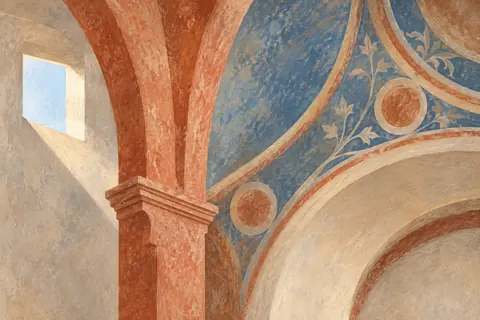
First look along the main axis, where visitors are permitted to stand. Notice the repeated coffers, the apparent recession of the vault and the way lines guide attention towards the altar. You do not need specialist vocabulary. Ask which edges seem parallel, which seem to converge and where your eye expects the next section of the room to begin. Looking quietly for a minute is often more revealing than immediately raising a phone.
Then, if worship, barriers and other visitors allow it, change your viewing angle from an accessible public area. The official tourism account describes how a side view exposes the shallow arrangement. There is no need to approach the altar or cross a restricted boundary to prove the point. If you cannot move to an appropriate position, an official photograph or a later drawing can help. The church’s use as a place of prayer takes precedence over completing a visual experiment.
Keep the illusion connected to the building
A good second question is what the surrounding architecture contributes. A compressed choir would have less impact if it floated on a blank wall. Its effect depends on continuity with the proportions, materials and rhythms around it. Compare the apparent weight of a supporting element with the lightness of painted recession. The interest lies in their cooperation. Knowing that part of the depth is illusory need not make the experience less convincing or less beautiful.
This is a useful companion to looking at painting and architecture in the Portinari Chapel. The buildings offer different problems and solutions; they are not interchangeable examples of one decorative trick. At San Maurizio, meanwhile, the arrangement of a church can lead you to ask how people used its spaces. Taking one question from each visit is more memorable than collecting a string of superlatives.
Make a modest plan for a working church
Check the current visitor information before setting out, and be prepared for services or local arrangements to limit sightseeing. Dress with the setting in mind, keep conversations low and follow the rules on photography. Treat opening hours as permission to enter an active religious place, not a guarantee of unrestricted movement or uninterrupted access to every corner. If you need a step-free approach, ask about the actual route rather than assuming that a compact church must be straightforward.
Leave a little time outside to understand the tight urban setting. A visit need not become an exhausting itinerary of every nearby monument. Browse our Milan history experiences if you would like a guided context, checking whether this church is explicitly included. For a separate city comparison, Turin’s San Lorenzo offers another way to think about the eye and architectural space. Neither a shopping walk nor a general city tour should be assumed to include special church access.
Sources & further reading
Turn a good read into a great day.
Find a highly rated Milanese experience that brings these stories to life.
Explore related experiences →