Milan’s Portinari Chapel: how do painting and architecture work together?

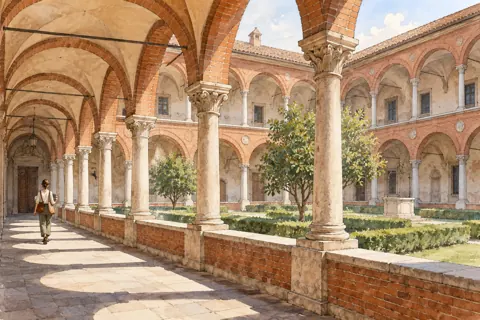
Milan’s Portinari Chapel rewards a small change of habit. Before choosing a painted figure to photograph, look at the room that holds it. Arches, windows, coloured surfaces and sculptural decoration work together, encouraging your eyes to move between real space and painted space. The pleasure is in that conversation, rather than in collecting one famous image and hurrying back outside.
The chapel belongs to the Sant’Eustorgio complex, but its visitor entrance is through the museum route. A visit to the basilica does not by itself settle the chapel’s opening arrangements or admission. Check the museum’s current information before making this the fixed appointment in your day, especially around holidays or religious occasions.
Begin with the shape of the room
The museum dates the chapel to roughly 1462–1468 and connects its commission with Pigello Portinari, the Florentine banker who directed the Medici bank in Milan. It describes a square principal space, a smaller square apse and a dome divided into sixteen sections. These are useful starting points for looking; you do not need to memorize a list of architectural terms.
From a permitted stopping place, trace where a vertical line meets a curve. Notice whether a window interrupts a surface or seems neatly fitted into a larger rhythm. Then move a little, without blocking the route, and see how those relationships change. A compact room can offer several distinct viewpoints. A photograph from its centre will not exhaust what it has to show.
Let the decoration lead you between materials
Terracotta ornament frames openings and arches, while Vincenzo Foppa’s paintings introduce figures and stories into the architectural setting. Choose one boundary between a painted area and a shaped surface. Does the frame make the image feel like a separate picture, or does it help the story belong to the room? This is an invitation to observe, not a test with a single correct answer.
Our guide to Milan’s San Maurizio offers another way to think about painting within a church. The buildings have different histories and layouts, so resist treating one as a substitute for the other. If you visit both, take away a comparison about how you looked, rather than trying to rank their decoration.
Keep the building’s history open to questions
The museum discusses uncertainty over the chapel’s architectural attribution. It is better to acknowledge that uncertainty than to attach a famous architect’s name to the whole ensemble as an established fact. Patronage, design and execution can involve different people, and historical interpretation changes as evidence is reconsidered.
The central marble shrine also has its own history: the museum identifies Giovanni di Balduccio’s work as originally made for the basilica before its later placement here. Its present position therefore brings together objects and architecture from different moments. Ask what belongs to the chapel’s original project and what arrived later. The answer need not make the room less coherent; it makes that coherence more interesting.
Remember that seeing is also a history
The basilica’s account explains that the painted decoration was rediscovered in the nineteenth century after a period of concealment. The surface you encounter has a history of recovery and care. Avoid assuming that every visible area has remained exposed and unchanged since the fifteenth century. Museum interpretation is the right place to look for distinctions between surviving work and later intervention.
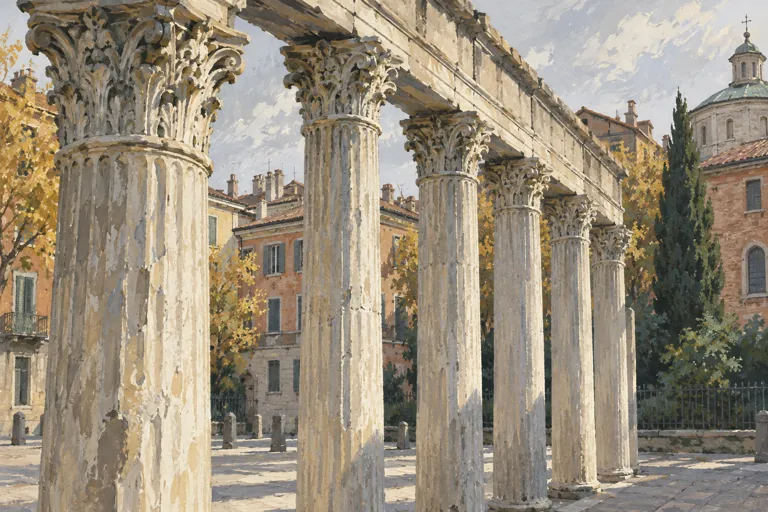
For another nearby lesson in long architectural lives, consider the San Lorenzo columns. Or use our Sant’Ambrogio guide to practise noticing how entrances and courtyards shape an approach. Each visit can be worthwhile without squeezing all three into one afternoon.
Make the appointment fit your day
Allow time for the museum route and for a quiet second look, rather than assigning the chapel only the minutes left before lunch. Ask staff about photography, seating and the accessible route that is available during your visit. If steps, standing time or lighting matter to your group, describe those needs precisely before booking.
You can compare Milan history experiences, checking whether Sant’Eustorgio and the chapel are actually included. On a separate Verona stay, the cathedral complex offers another reminder that one religious site can contain several distinct spaces. Here in Milan, a satisfying visit ends with a simple skill: noticing where architecture shapes the way you see a painting.
Sources & further reading
Turn a good read into a great day.
Find a highly rated Milanese experience that brings these stories to life.
Explore related experiences →