Milan’s San Lorenzo columns: ancient stone in a living city

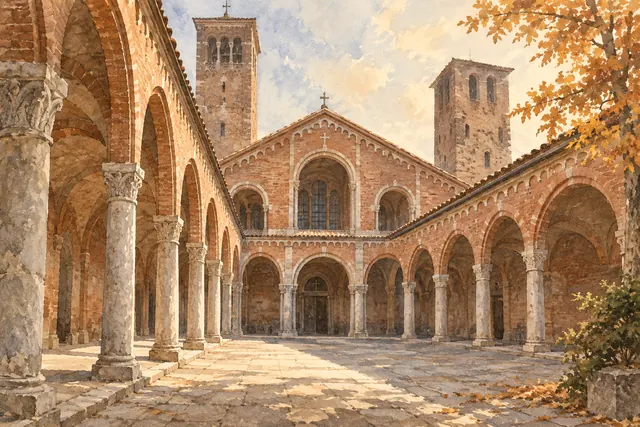
Milan’s San Lorenzo columns are a reminder that ancient architecture can remain part of ordinary city life. The colonnade stands in front of the basilica along the Porta Ticinese area, where the setting is active rather than sealed off as a remote ruin. Give it a few attentive minutes and the familiar postcard view becomes a set of questions about materials, movement and reuse.
Start by separating three things: the ancient columns, their later arrangement and the present-day square around them. They are related, but they did not all appear at the same moment. That distinction makes the place more revealing than a simple label such as “Roman Milan.”
Understand reused stone
The civic archaeological itinerary published through the Milan Chamber of Commerce describes the marble colonnade in relation to San Lorenzo and the reuse of earlier architectural elements. Reuse gives an object more than one history: its making, its first setting, its relocation and its survival within a changed city.
You do not need to settle the original source of each piece by looking at it. Instead, notice why that question matters. A column standing here today is evidence of ancient workmanship, but its current neighbours and purpose may belong to another phase. Avoid mentally reconstructing an entire temple or bath building from an attractive but uncertain association.
Look at the rhythm, then the differences
The University of Padua’s archaeological record for San Lorenzo describes the monumental columned frontage associated with the basilica. From a safe viewing position, look first at the sequence as a whole: upright shafts, capitals and the horizontal line they support. Repetition creates a strong impression even before you study any individual detail.
Then choose two columns to compare. Are the surfaces equally weathered? How does shadow change the carved leaves of a capital? Which edges remain crisp, and which appear softened? These are observations, not diagnoses. Damage, restoration and original carving cannot always be distinguished confidently by an untrained eye, but noticing a difference is a useful beginning.
Keep the church’s long life in view
The basilica behind the columns has also undergone changes over time. An early foundation does not mean that every visible part belongs to that earliest phase. The civic archaeological guide explicitly treats San Lorenzo’s present appearance as the result of successive interventions. Let the contrast between continuity and alteration be part of your visit.
Our Sant’Ambrogio guide develops a related way of reading church architecture in Milan. The point is not to make the buildings equivalent. It is to carry a good habit between them: distinguish foundation, surviving fabric and later changes before reducing a place to one century.
Enjoy the public setting without treating it as a stage
Choose a place to pause that leaves the pavement and crossings clear. A lively square can make careful looking surprisingly enjoyable, but it also asks visitors to share space considerately. Do not climb on the monument, lean equipment against historic surfaces or move into the street for a more symmetrical image.
If you want to enter the basilica or another part of the complex, check its own current visitor arrangements. The ability to see an exterior from public space does not establish opening hours, ticket rules or access inside. Plan a separate interior visit only when you have confirmed the relevant details for the day.
Use the columns as one stop in a purposeful walk
A route through this part of Milan can connect architecture with a relaxed meal or an evening elsewhere, rather than becoming a rapid inventory of churches. Our walking-tour comparison guide helps you assess route, pace and subject. Ask whether a guide will explain the places that interest you, not only how many landmarks appear in the description.
For a later change of atmosphere, the Navigli evening guide offers another way to experience the city. Allow time to reach the area and choose your own pace; a thematic connection does not turn separate stops into an instantaneous transition.
If your holiday includes Verona, its wider Roman history makes an interesting comparison with Milan’s surviving fragments. Explore our Milan history experiences for additional guided options. The best result is not simply recognising more old stones. It is learning to ask what survives, how it arrived here and which parts of the story remain uncertain.
Sources & further reading
Turn a good read into a great day.
Find a highly rated Milanese experience that brings these stories to life.
Explore related experiences →