Milan’s Ca’ Granda: how should you explore a university with a hospital’s history?

The Ca’ Granda gives a Milan walk a different tempo. At the University of Milan’s historic headquarters, a courtyard may hold architectural detail, a hurried conversation and someone looking for a lecture room at the same time. Its value as a visitor stop comes partly from that mixture. This is a working university with a long history, so explore the public route without treating every doorway as an invitation.
The university identifies the building as the former Ospedale Maggiore, founded in the fifteenth century under Francesco Sforza. Its present identity developed much later. Keeping those two uses in mind helps you read the courtyards as more than a picturesque setting: they belong to a building repeatedly adapted to collective life.
Start with the public interpretation
The university describes a self-guided historical route marked by eleven information points in the central courtyard, other courtyards and the portico along Largo Richini. Use these to establish where you may go and what you are looking at. The interpretation is a better guide to the building’s phases than an assumption that everything sharing a similar colour was constructed together.
Choose one courtyard and look along its edges before walking across it. Repeated arches create a rhythm, but small differences may be worth noticing. Compare a corner with the middle of a side, or the view through one opening with the view from the next. You can do this quietly and without turning a circulation route into a photography studio.
Read a hospital’s afterlife carefully
A former hospital can prompt questions about light, circulation and the relationship between shared space and enclosed rooms. Those questions are useful, but do not let an attractive architectural theory stand in for documented history. Read the signs for the original purpose of a space rather than deciding from its appearance that it must have been a ward or dispensary.
For a broader introduction to patronage in the city, our article on Milan’s Renaissance patrons at Sforza Castle provides a complementary starting point. It is a separate building and story. Comparing institutions can be illuminating without assuming that all their founders pursued identical aims or that all their spaces worked in the same way.
Notice restoration without hunting for a flawless past
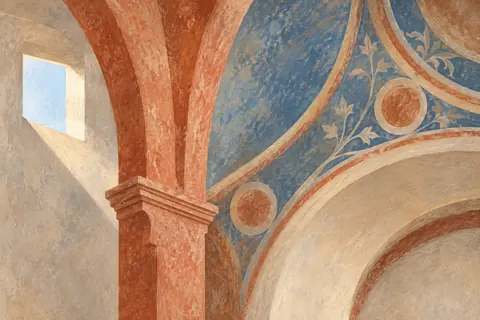
The university records severe bombing damage in 1943, restoration beginning in 1951 and its formal establishment here in 1958. The courtyard you see today therefore belongs to a twentieth-century recovery as well as to much older building campaigns. It is not an untouched historical enclosure accidentally filled with students.
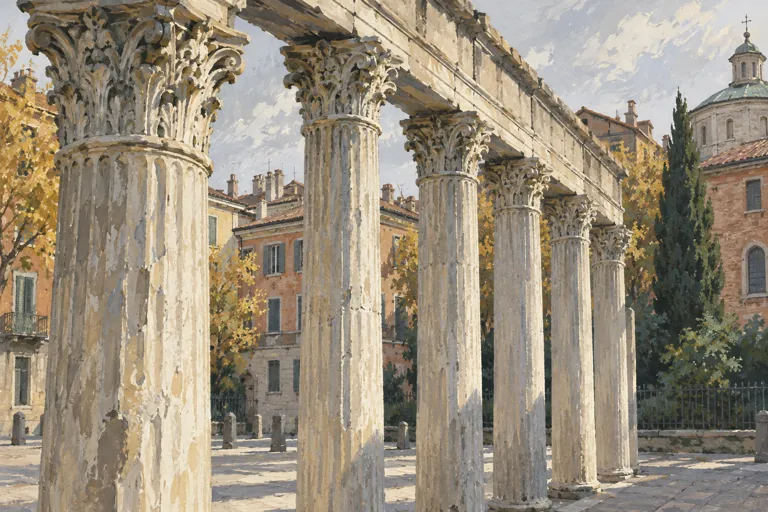
Try to distinguish what the interpretation identifies as recovered material, restored structure or later adaptation. Where it does not provide an answer, leave the question open. Surface colour alone is unreliable evidence. Our Bagatti Valsecchi Museum guide offers a different exercise in separating the age of an object from the age of its arrangement, while the San Lorenzo columns raise another question about old material within a changing city.
Treat guided visits as a separate option
The university advertises bookable visits to historic spaces, with dates and arrangements published through its cultural programme. These should not be confused with an independent look at accessible courtyards. A room appearing in an event brochure or virtual tour is not proof that you can enter it on an ordinary weekday.
Before setting out, check the current university visitor information and any specific reservation instructions. If your main interest is a space such as the Crociera, establish that the visit actually includes it. Ask about steps, lifts and the route available on that date if mobility is a concern. University business and special events can affect what visitors are able to see.
Leave room for the people using it
Keep conversations low beside teaching spaces, avoid photographing identifiable people without permission and follow signs where areas are reserved. A good visit need not be long. One carefully read information panel and a few minutes comparing views can be more memorable than trying every staircase. The building continues to function; that is part of its interest.
For a guided city context, explore Milan history experiences and read the actual itinerary before expecting university access. On another northern stop, Turin’s OGR tells a very different story of a building gaining a new cultural role. The Ca’ Granda’s particular reward is the chance to see historical fabric and everyday learning occupy the same place.
Sources & further reading
Turn a good read into a great day.
Find a highly rated Milanese experience that brings these stories to life.
Explore related experiences →