Milan’s Renaissance patrons: reading power at Sforza Castle

A castle can be a defensive structure, a residence and a statement about who deserves to rule. Milan’s Sforza Castle is a useful place to hold those ideas together. Instead of collecting famous artists’ names, try asking who commissioned the work, whom it was meant to impress and how its setting shaped the message.
This is a way of looking, not a claim that every visible surface dates from the Renaissance. Start with our introduction to Sforza Castle for the broader visitor picture. Then give yourself one focused theme: how patronage connects artistic skill with political ambition.
Begin with a building that changed owners and purposes
The castle’s official history traces its origins to Galeazzo II Visconti in the fourteenth century. It describes partial demolition during the Ambrosian Republic and rebuilding under Francesco Sforza, followed by the courtly setting associated with Galeazzo Maria Sforza and Ludovico il Moro. Leonardo and Bramante worked in this Milanese cultural world.
That sequence makes the word “Renaissance” more useful when attached to particular people and projects. It was not one synchronized transformation of the whole city. Ask which phase a guide or label is discussing. A change of ruler, a new room decoration and a later reconstruction may all be visible within the same short walk, but they require different explanations.
Ask what a commission actually purchased
A patron could support a work for devotion, prestige, practical use or several purposes at once. The finished object might advertise resources and cultivated taste while also serving a specific room or ceremony. Those possibilities are questions to bring to individual evidence, not motives to assign automatically to every painting or building.
Look at scale, placement and access. Was the work positioned for a broad public, a restricted circle or people passing through a threshold? Would its materials have been conspicuous? A beautiful surface can invite delight while also organizing attention. You can appreciate the skill and still ask who paid for it and whose labor the polished result tends to hide.
Keep the artist and the patron in the same story
It is tempting to treat a famous artist as an independent genius dropped into a city. A court setting encourages a richer question: what opportunities and constraints came with a commission? Plans, payment, available space, workshop collaboration and the intended audience all belong beside personal invention.
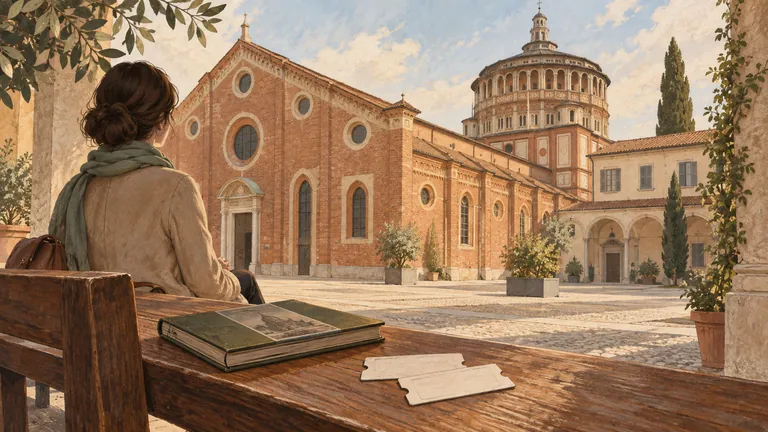
Our Last Supper planning guide concerns a separate reserved visit. Do not assume that a castle tour includes it because both places connect with Leonardo’s Milan. If you visit both, compare how each setting directs the viewer’s attention, while keeping their different functions and access arrangements clear.
Learn to recognize the later layer
The castle’s official account of its towers and ramparts discusses the Torre del Filarete and the work of Luca Beltrami. The tower’s Renaissance association does not make everything you see an untouched survival. Restoration can itself express a later generation’s ideas about a city and its past.
Before identifying a detail as evidence of fifteenth-century patronage, check its date and history. Ask whether it survives in place, has been restored, was reconstructed or has been moved into a museum arrangement. These distinctions do not spoil the visit. They let you enjoy the building without asking it to provide a simpler story than its history supports.
Use objects to test a broad idea
Inside a collection, choose one object rather than trying to turn every gallery into an illustration of the same argument. Read its maker, date, material and provenance where supplied. Does the label identify a commission, an original location or an owner? If not, keep the uncertainty visible rather than supplying a courtly anecdote of your own.
Our Brera visiting guide offers another opportunity to practice this attentive approach on a different day. A work now displayed in Milan may have been made for another location. Where it was produced, where it originally functioned and where it is exhibited today are three separate parts of its biography.
Choose a visit that explains rather than merely names
Browse Milan history experiences and inspect the actual itinerary. If your interest is patronage, look for enough time at relevant sites and clear information about interiors. Ask which parts of the castle are included; a courtyard explanation and a museum visit offer different encounters.
Leave a little unstructured time afterward. Look back at an entrance, a tower or a decorated surface and ask whether you now understand its choices differently. The reward of studying patrons is not memorizing a succession of surnames. It is seeing artistic achievement within the relationships, resources and changing ambitions that helped make it possible.
Sources & further reading
Turn a good read into a great day.
Find a highly rated Milanese experience that brings these stories to life.
Explore related experiences →