How should you visit Milan’s Chiaravalle Abbey?

Chiaravalle offers a change of pace within Milan: a monastery whose life cannot be reduced to a visitor route. Its address, Via Sant’Arialdo 102, belongs to the city, yet planning a visit here requires a different rhythm from stepping between central museums. The useful question is not how quickly you can collect another landmark. It is which parts you hope to see, when those parts admit visitors, and how much unhurried time you can give them.
Start with the monastery’s timetable
The abbey’s own website separates tourist visits from access for prayer. That distinction matters. A church may be open for worship while its choir, transepts or cloister are outside ordinary visiting arrangements. The current information also directs visitors towards organised visits on weekend afternoons and holidays. Read the visitor page for your precise day, then check the liturgical notices. Do not interpret a broad church opening time as permission to wander through every part of the complex.
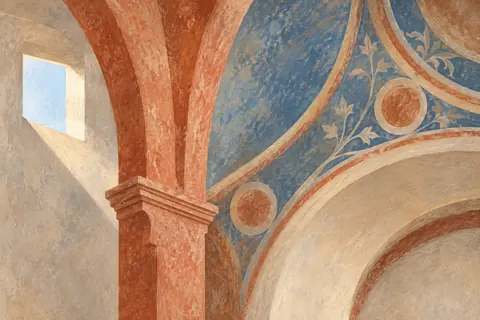
Chiaravalle traces its foundation to the twelfth century and Saint Bernard. That history is a starting point, not a reason to imagine the whole site frozen in one medieval moment. Buildings carry repairs, additions and changing uses. Begin by looking at the different relationships between enclosed space, movement and light. A wall that appears plain beside a painted surface may deserve just as much attention. You do not need to identify every century to recognise that several kinds of work have shaped what survives.
Choose a route with the right inclusions
The official guided programme distinguishes a church-and-cloister visit from the Chapel of Saint Bernard and the mill. The church route introduces painted decoration, the choir, chapter house and views towards the tower known as the Ciribiciaccola. The chapel has its own painted interior, while the mill directs attention towards work and production. Treat those as different opportunities. Booking one does not establish that the others are included or open at the same time.
Weekday audio-guided arrangements are also described on the official site, with devices distributed through the information point. Availability depends on its opening hours. If language, step-free access or a particular room is essential, ask the information point before committing to the journey. The monastery currently describes the church and cloister as accessible without architectural barriers; that statement should not be extended automatically to every guided space, approach or additional activity. Specify the route you actually want to use.
Look at the spaces between the artworks
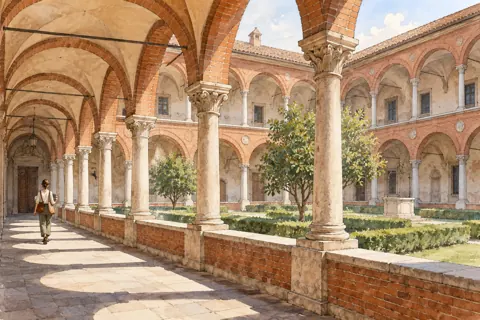
Inside, try following one architectural relationship rather than chasing every detail. How does a doorway frame the next room? Where does daylight make a surface easier to read? Does a repeated arcade encourage walking, or invite you to remain still? These are observations you can make without treating the monastery as a puzzle with a single correct answer. Keep voices low, follow instructions and allow worshippers their space. A service is a community’s activity, not a performance arranged for a camera.
The mill offers another possible question: what does a religious foundation need beyond a church? The abbey’s visitor programme connects the complex with working life as well as spiritual life. You can use that connection to think about labour, resources and maintenance without inventing a complete account of medieval farming from a picturesque view. A surviving building or demonstration is evidence of something specific; it is not proof that every detail has remained unchanged since the foundation.
Build a Milan day with room around it
Check your outward and return public-transport journeys for the actual date. Our Milan transport guide helps with the planning habits, but a route planner and current service notices should decide the journey. Leave space between arrival and a timed visit. Avoid placing a central museum reservation immediately after the abbey unless you have checked the transfer and allowed a margin. A calm visit is easily undone by a nervous return trip.
For comparison within Milan, Sant’Ambrogio’s courtyard and towers and San Maurizio’s divided interior show other relationships between architecture and religious life. If your wider journey reaches Lake Como, Piona Abbey near Colico belongs to a separate lakeside itinerary, not a nearby Milan add-on. Compare our Milan history experiences by their stated route and inclusions; Chiaravalle admission should never be assumed from a general city-tour description. A carefully chosen visit gives the abbey enough space to remain a living place.
Sources and planning information
Monastero di Chiaravalle — The abbey; Monastero di Chiaravalle — Guided visits; Monastero di Chiaravalle — Contacts and opening arrangements. Current information checked on 16 October 2026; consult the official pages again before travelling.
Sources & further reading
Turn a good read into a great day.
Find a highly rated Milanese experience that brings these stories to life.
Explore related experiences →