Milan’s Certosa di Garegnano: how do you plan a visit beyond the centre?

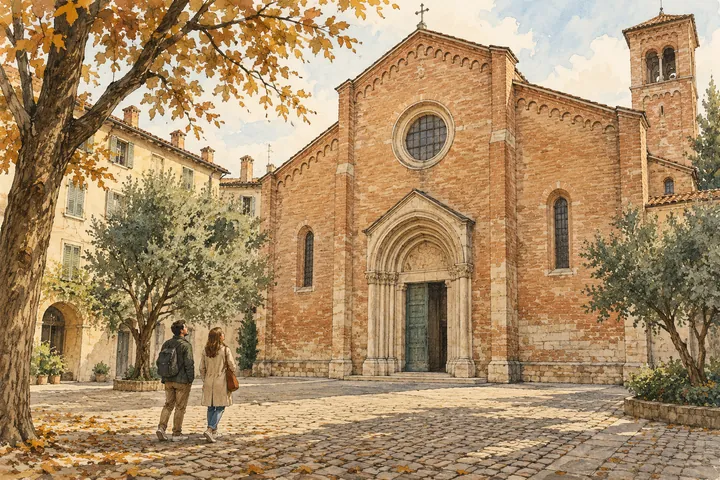
Milan’s Certosa di Garegnano rewards a deliberate journey. It sits northwest of the historic centre, so it works better as the focus of a separate outing than as an extra doorway squeezed between the Duomo and Brera. Begin by deciding whether you want quiet independent looking or a confirmed guided visit. Then check the church’s current arrangements and allow enough travelling time to arrive without treating the first fresco as a race checkpoint.
Which history belongs to the place you see now?
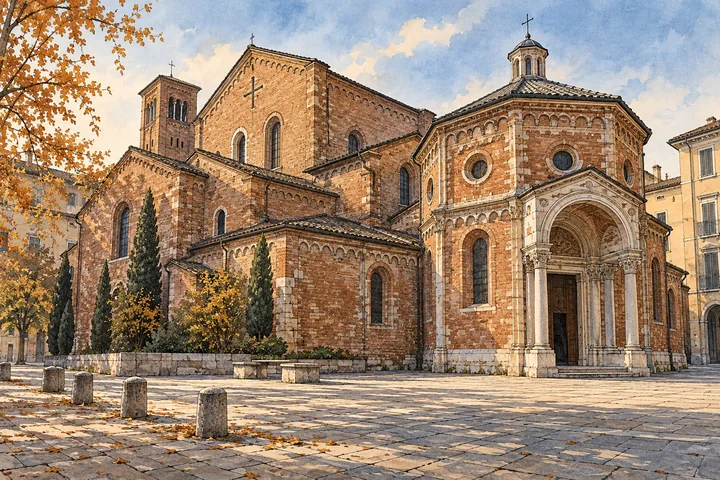
The Certosa’s official history records its foundation by Giovanni Visconti in 1349 for the Carthusian order. It also explains that the complex changed substantially from the sixteenth century onwards. The founding date therefore gives the institution an origin; it does not date every wall, painting or detail visible today. That simple distinction makes an architectural visit much more interesting than searching for an imagined untouched medieval building.
The same history records the suppression of the monastery in 1782 and the later adaptation of the church for parish worship. Today’s visitor enters a living religious setting with a monastic past, not a promise of access to an operating Carthusian monastery. Ask how successive uses altered the place. A building can carry memories of withdrawal from the world while serving a neighbourhood that has become part of a much larger city.
It helps to bring one comparison rather than a list of famous churches. Our guide to Chiaravalle Abbey introduces another distinct excursion beyond central Milan. Do not combine the two simply because both have monastic histories: their locations and visitor arrangements need separate planning. Choose the one that answers your interest, then give it enough time.
How do the paintings organise your attention?
The official art guide identifies Daniele Crespi’s work in the nave and vault, completed in 1629, and Simone Peterzano’s earlier work in the presbytery. These are useful anchors for a first visit. You do not need to identify every scene immediately. Start by noticing how the decoration relates to the room: where pictures sit above the viewer, how they are framed, and which direction the architecture encourages you to face.
Then choose a single scene and slow down. Where does your eye enter it? Which gesture seems to connect one figure with another? Can you distinguish an architectural frame from architecture depicted inside the painting? Describe what you see before attaching an interpretation. If the official guide identifies an episode, return to the image with that information and ask what became clearer. A religious narrative is not a documentary photograph of the event it represents.
Different parts of the room may demand different viewing distances. Avoid repeatedly stepping backwards without looking behind you, and leave aisles clear. The divided interior of San Maurizio offers another way to think about who saw an image and from where. San Satiro’s use of perspective makes a useful comparison for the relationship between actual space and visual suggestion. These are questions to carry with you, not reasons to force all three churches into one afternoon.
Is a guided visit the same as ordinary church access?
No. The Certosa’s visits page distinguishes individual visits during permitted opening periods from the parish’s scheduled guided visits and organised group arrangements. The current 2026–2027 programme requires online registration for its listed individual guided visits. A place on a dated guided visit should be confirmed through the stated process; ordinary opening information does not reserve one.
The page also makes worship the priority. Sightseeing pauses for services and prayer, and suitable dress and behaviour are expected. Photography rules allow amateur photographs without flash; professional filming or photography requires authorisation. Read the current instructions before taking equipment, and never assume that a door beside the church leads to a public visitor area. The art guide explicitly identifies the sacristy as not visitable.
How do you make the journey comfortable?
Use the official location and contact information for Via Garegnano 28, then check the current public-transport route for your starting point. Do not confuse this Certosa with the Certosa di Pavia. Keep a return route available and confirm accessibility needs with the venue before travelling; a historic interior and its approach deserve more precise questions than a generic “accessible” label.
If you would like a broader guided day, review the named stops, departure point and inclusions in our Milan experience collection. A city tour does not automatically reach Garegnano. For another trip, Turin’s San Lorenzo and Guarini’s dome offers a contrasting architectural conversation. Here, let the Certosa remain the main event: a journey out, patient looking, and time to leave without interrupting the life of the church.
Sources & further reading
Turn a good read into a great day.
Find a highly rated Milanese experience that brings these stories to life.
Explore related experiences →