Milan’s San Simpliciano: how do you read an ancient foundation through later architecture?

San Simpliciano rewards a question that is useful throughout Milan: when we call a church ancient, which part of its history do we mean? The foundation, the surviving walls, the appearance of the façade and the arrangements inside may belong to different moments. In the small piazza off Corso Garibaldi, you can begin that investigation without trying to identify every architectural detail. Look first, then let the dates complicate the view.
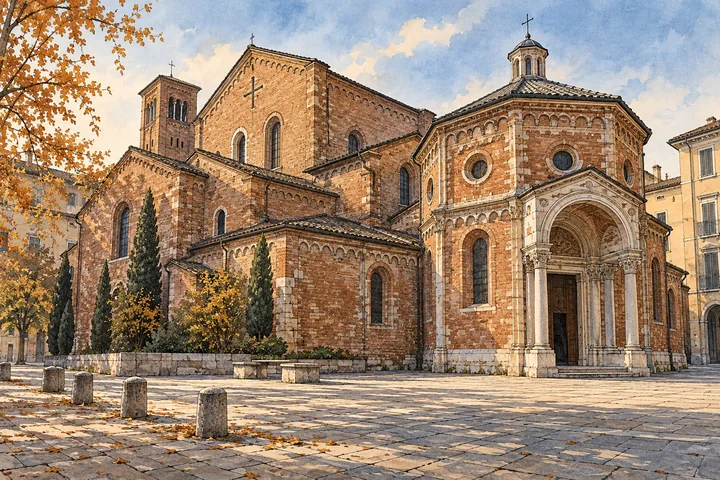
The official YesMilano introduction connects the church’s foundation with Ambrose in the fourth century and its completion with his successor Simplicianus. It was originally known as the Basilica Virginum. The brick frontage you encounter today, however, has a Romanesque character. Foundation history and visible style are not competing answers: they describe different stages in the life of the same place.
Start outside with proportions
Stand where you can see the entrance and the broader wall surface without blocking the doorway. Notice how the opening, brickwork and upper part of the façade relate to one another. You need not assign a date to every patch to recognise that a building can accumulate changes. A first sketch consisting of a few rectangles and arches may reveal more than a hurried photograph of the whole frontage.
This is a good continuation of a visit to Sant’Ambrogio, provided you allow each church its own story. Similar materials do not prove that two walls were built together, and a shared association with Ambrose does not make the buildings interchangeable. The interest lies in the differences: what each setting lets you see, how people approach it, and how later generations have maintained it.
Let the interior change your pace
If the church is open for visits, move in quietly and take a moment before walking further. A church is organised around worship as well as sightlines. Notice where people sit, which spaces are in use and whether there is a service or private moment that should take priority over sightseeing. The official visitor page lists free entry, but that does not mean every adjoining area is available at every hour.
Look towards the apse and consider the relationship between the architecture and its imagery. YesMilano’s access description identifies Bergognone’s Coronation of Mary there. Treat the work as part of a particular religious setting rather than as an isolated picture to collect. Our San Maurizio guide offers another example of how understanding a church’s spaces can change the way you look at its decoration.
Check the route rather than assuming access
The city’s detailed access page records steps, a metal ramp and a small threshold at the approach. It also distinguishes the main visiting area from spaces reached by further steps. Its current description says that the side chapels are not generally visitable, with a specific exception for the confessional chapel. Do not build an itinerary around unrestricted access to all the chapels or the sacellum.
Those details are especially relevant if you use a wheelchair, travel with a pushchair, or find steps tiring. Contact the church about your precise needs and the route available on your chosen day. A general description such as “accessible” can conceal important differences between reaching the nave and reaching every feature. There is no need to turn a short visit into a difficult one just to complete an imagined circuit.
Give the neighbourhood some time too
San Simpliciano can be a focused stop during a Brera walk, rather than another appointment squeezed between large museums. After leaving, pause in the piazza and compare your first impression with what you learned inside. The building has not changed, but your description of it may have become more precise. That is a useful measure of a good history visit.
If you prefer an interpreted route, compare the actual stops in our Milan history experiences; a walking tour does not automatically include church interiors. On a wider northern itinerary, Verona’s San Lorenzo provides a thoughtful architectural comparison. Keep the comparison modest: use it to sharpen your eye, not to flatten two distinct churches into one general idea of the medieval past.
Sources & further reading
Turn a good read into a great day.
Find a highly rated Milanese experience that brings these stories to life.
Explore related experiences →