Why does Milan’s cathedral use pink-white marble?
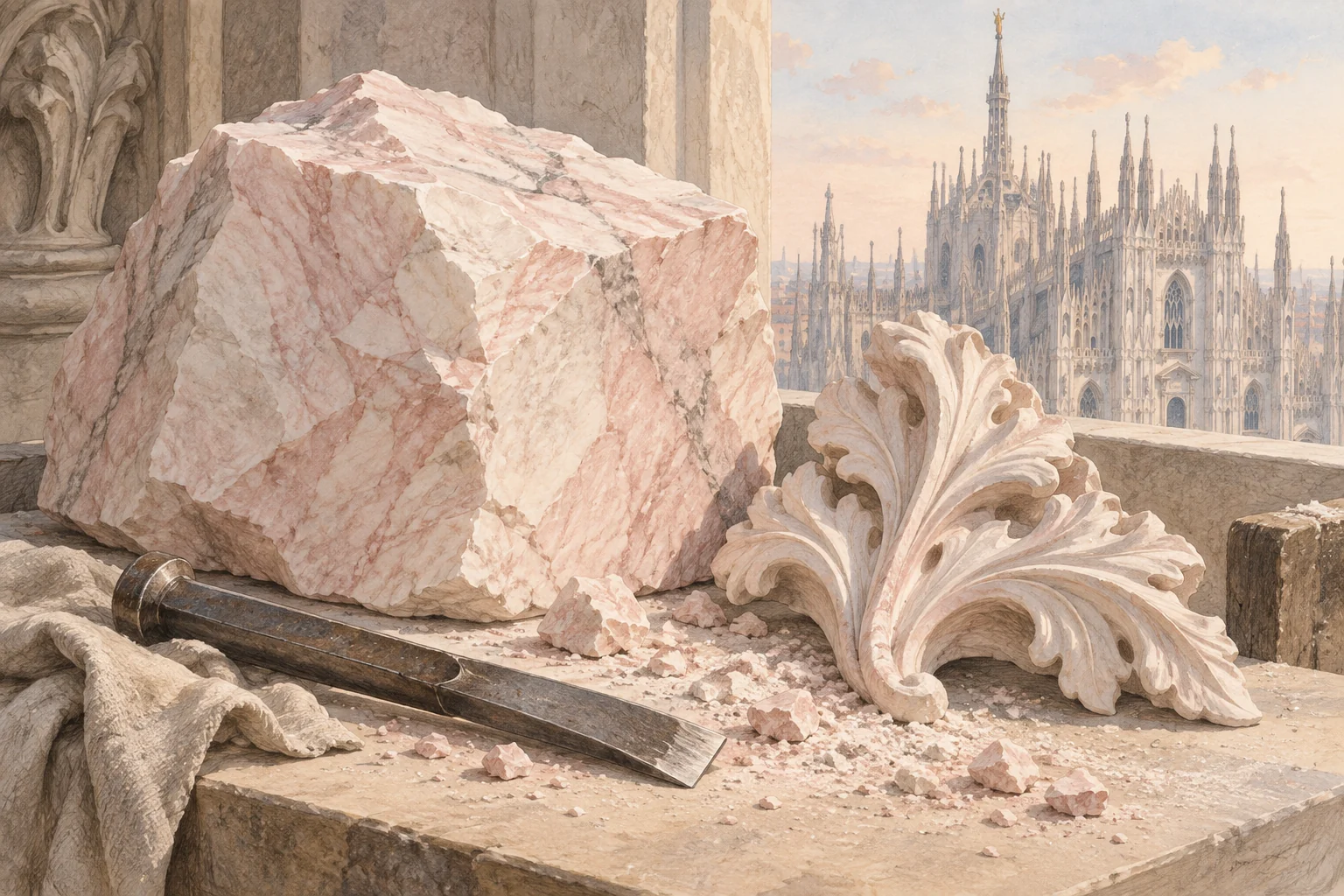
Milan’s cathedral is not uniformly white. Look patiently from the piazza and you may notice warm pink, cool grey and creamy tones moving across its surface. The answer begins with Candoglia, the source of the marble chosen for the Duomo. But this is more than a story about an attractive stone. Choosing a material also meant organizing a landscape, a transport system and generations of specialist work. A little knowledge of that chain can make your next cathedral visit much more rewarding.
A choice that changed the building
The Veneranda Fabbrica’s official account of the Candoglia quarry explains that Gian Galeazzo Visconti replaced the original proposal to use brick with marble. In 1387 he granted the quarry to the cathedral’s building institution and free transport by water. Candoglia lies near Mergozzo, in Piedmont, rather than in central Milan. The decision therefore connected the cathedral to a distant source of stone from the beginning.
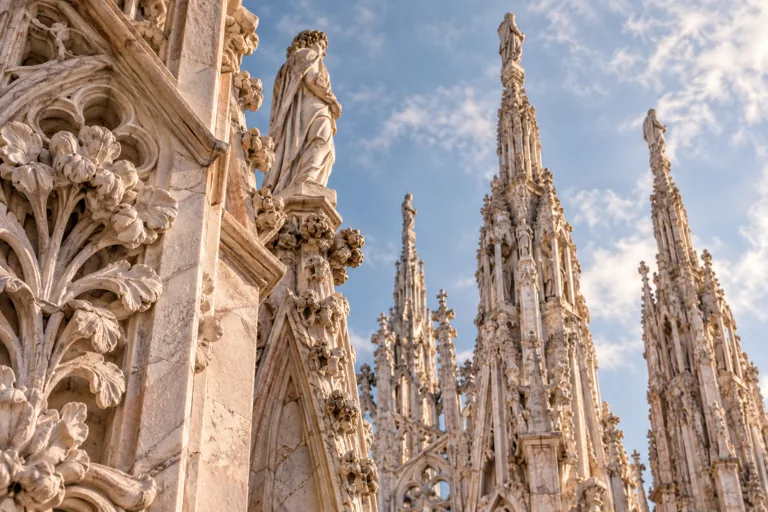
It helps to separate the historical decision from your own experience of the result. You need not imagine exactly what the unrealized brick building would have looked like. Instead, notice how a pale surface makes the spaces between carvings more legible. Shadow becomes a drawing tool. A leaf, a fold or the edge of an arch can emerge through a small change in light rather than a dramatic change of color.
The journey mattered as much as the quarry
The stone traveled through a connected water route: the Toce, Lake Maggiore, the Ticino and Naviglio Grande brought it toward Milan. The Fabbrica describes its onward passage to a small city basin near the cathedral works. Water transport continued until 1920, after which road transport took over. These are useful reminders that a building in a central square can depend on places far beyond the visitor’s walking map.
You can connect that idea with an evening around the Navigli. Do not expect a present-day canal walk to recreate the whole historic delivery route. Much has changed, and a romantic view is not a shipping diagram. The worthwhile connection is simpler: waterways once helped carry the material of the city, as well as supplying the atmosphere visitors now enjoy.
Look at color without trying to date it
When looking at the cathedral, choose a small area you can study without blocking movement. Compare a broad plane with a recessed carving beside it. Then look away briefly and return. This is an easy way to notice how much of your impression comes from light and shadow. A phone photograph may turn a subtle pink into a stronger tint, or flatten several tones into one.
A visibly different patch is not, by itself, a reliable date label. Avoid assigning an age to a piece merely because it looks lighter or darker. If a guide discusses a replacement, ask which evidence identifies it. Our guide to the cathedral’s long construction story provides the broader framework; a material-focused visit adds a closer scale of attention.
Craftsmanship continues after construction
The Fabbrica’s description of its marble yard makes clear that cathedral stonework remains an active craft. Specialists turn quarry material into architectural pieces, ornaments and sculpture. Modern machinery helps with preparation, while skilled finishing remains important. The workshop is part of the Duomo’s present life, not simply a historical footnote attached to the finished monument.
For visitors, this changes the meaning of scaffolding. A protected section may interrupt the view you hoped to photograph, but it also points to continuing care. Rather than treating maintenance as an inconvenience to edit out mentally, ask how an exposed building survives. You do not need to know the conservation treatment of every surface to appreciate that preservation involves decisions, labor and repeated attention.
Choose the right viewpoint for your interests
The piazza offers an introduction without committing you to every part of the cathedral complex. If close architectural details are your priority, consult our rooftop planning guide and check current access arrangements. A terrace visit has different physical demands from looking at the façade. Do not assume that choosing a lift removes every possible step or difficult surface from the complete route.
When comparing Duomo experiences, read what the itinerary actually covers. A tour emphasizing history, a terrace admission and a museum visit answer different questions. The quarry and working marble yard are not included merely because a guide talks about Candoglia. Pick one useful question to carry with you: how was this shape made, how does this stone catch the light, or how is this detail cared for? The cathedral becomes easier to remember when you leave with one answered question rather than a pocketful of disconnected dates.
If your trip also includes Florence, compare how the outside of each cathedral organizes color and detail before deciding which interiors to enter. Our sister guide to Florence Cathedral and dome access helps keep those separate visits clear. Carry the same looking question between cities, while checking each monument’s own admission arrangements.
Sources & further reading
Turn a good read into a great day.
Find a highly rated Milanese experience that brings these stories to life.
Explore related experiences →