How to read Milan’s Duomo: six centuries of making and remaking
The Duomo becomes more interesting when you stop expecting it to speak in one voice. Its size can encourage a quick verdict—magnificent, elaborate, enormous—before the looking has really begun. A more rewarding approach is to treat the cathedral as a long conversation among makers. Different parts ask different questions, and the building’s continued care belongs to its story rather than sitting outside it.
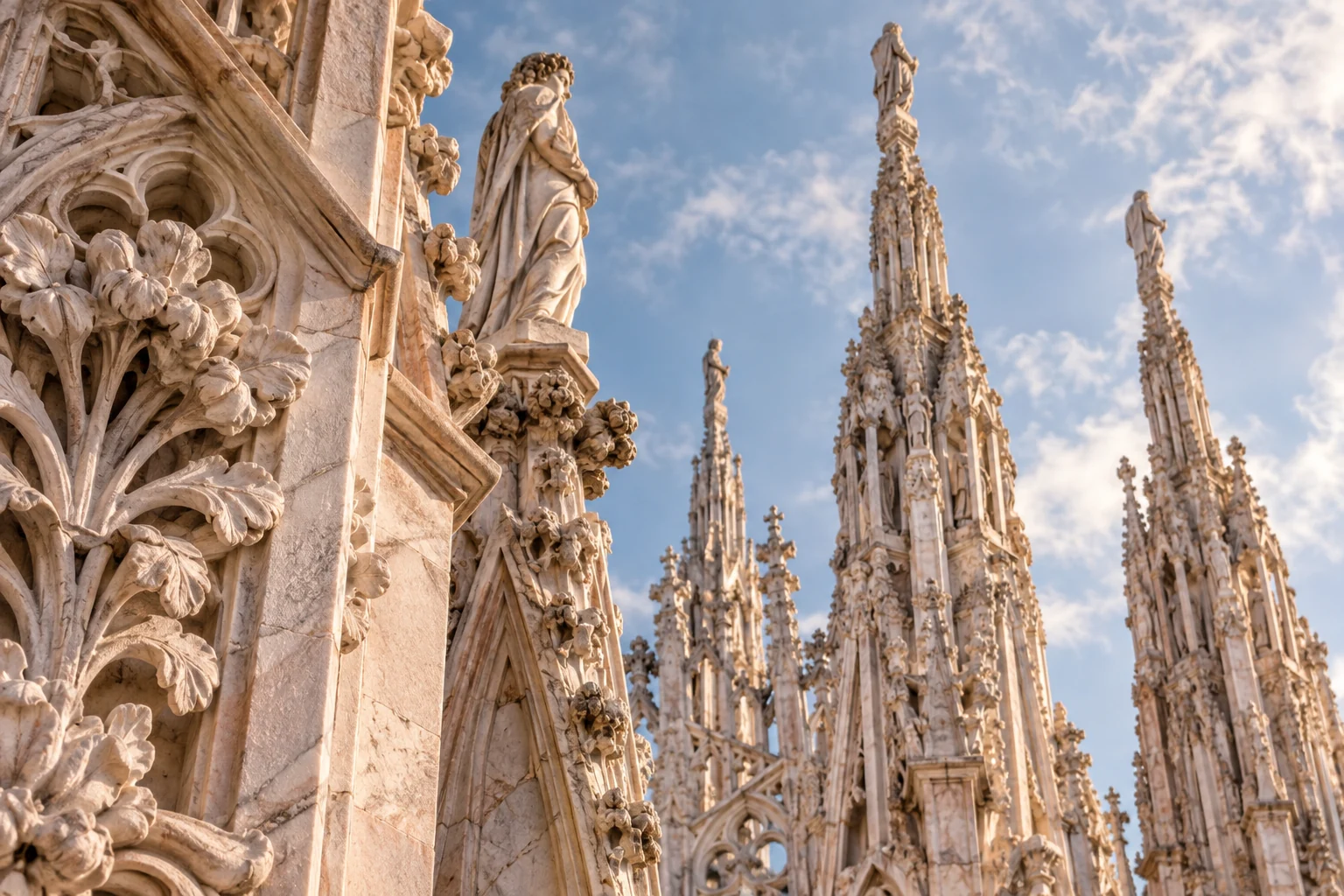
Start at a comfortable distance in the piazza. Let the outline settle before moving closer. Notice the contrast between the broad horizontal ground and the repeated upward movement of the stonework. Then choose a small section of the surface and examine how it is organized. This simple change of scale turns an overwhelming façade into something you can actually begin to read.
A beginning is not a completion date
The cathedral’s official history places the beginning of construction in 1386 and explains the decision to build in Candoglia marble. Those facts are a starting point, not a claim that everything visible belongs to that moment. Large historic buildings acquire additions, repairs and changing interpretations. Asking when a particular element was made is more useful than assigning one date to the whole.
Try separating three questions as you look: what is the element doing structurally, what is it communicating visually, and what signs of work can you observe? You may not know the answer to any of them. That uncertainty is productive. A guided visit can provide vocabulary, but careful observation already gives you something specific to ask about instead of waiting passively for a sequence of names.
Follow the material beyond the square
The marble has a geography of its own. The Veneranda Fabbrica’s quarry account links the cathedral to Candoglia and the historic waterways that transported stone toward Milan. The connection makes the building part of a wider working landscape: extraction, transport, carving and maintenance all lie behind the surface visitors admire.
Thinking about material changes a city walk. Waterways cease to be only picturesque scenery, and a carved block becomes evidence of coordinated labor. You can carry that idea into a later Navigli evening without imagining that every surviving canal view reproduces the medieval transport route. Connections enrich a visit most when they remain precise about what they do and do not establish.
Use the roof as another reading position
From the ground, rooftop details merge into a dense border against the sky. A terrace visit lets you see some of those relationships at a different scale. It does not replace the interior, and it need not be everyone’s priority. The rooftop decision guide can help you choose according to your interests and access needs.
If you go up, compare repeated forms rather than trying to catalogue them all. Look for how light passes between pieces and how a detail frames another part of the building. Keep the marked route and other visitors in mind. An architectural encounter can be attentive without being possessive; you do not need an empty platform to understand the way stone meets sky.
Make room for the building’s present life
The cathedral is also a place with active religious functions and contemporary caretakers. Dress, behavior and access should follow current official requirements. Notice how staff organize movement and where visitors are asked to pause. Respecting those boundaries helps you understand a living institution instead of treating it as an image available solely for personal use.
Finish by choosing one detail you would like to recognize again. That makes a return to the square feel like a reunion with something specific. Browse cathedral experiences if you would value a guide’s explanation, and save time afterward to look independently. Travelers continuing to Rome can compare the pleasure of reading buildings through its walking tours; the useful habit travels, while the history and architectural language change completely.
Look for evidence of care as well as age. A scaffold or a protected area may interrupt a preferred photograph, yet it also reminds visitors that survival requires work. Treat the cathedral’s maintenance as part of its living story, while following the official route and avoiding conclusions about a particular repair without an explanation from the people responsible.
Sources & further reading
Turn a good read into a great day.
Find a highly rated Milanese experience that brings these stories to life.
Explore related experiences →