Milan’s Gallerie d’Italia: how do you choose a route through its collections?

Milan’s Gallerie d’Italia rewards a decision made before the first painting: which conversation would you like to follow? The museum brings different collections and historic settings into one visit, but you need not turn that variety into a race. A nineteenth-century picture, a twentieth-century experiment and the building around them can each sustain a very good hour. Choose one as your starting point and keep the others as possibilities rather than obligations.
The museum’s collection overview distinguishes its nineteenth-century holdings, including works from Fondazione Cariplo, from Cantiere ’900 and the Caveau. These are useful headings for planning, not a promise that every object or space will be available on every date. Exhibitions, installations and room arrangements can alter a route. Begin with the institution’s current information, then give yourself permission to follow what is actually open and what holds your attention.
Start with the current entrance
The visitor page, checked on 24 October 2026, says entry is through Via Manzoni 10 until 25 November inclusive. That temporary arrangement matters: do not simply follow an old photograph of an entrance or assume the most prominent doorway is the one in use. Recheck the notice close to your visit, especially if you need a particular accessible approach. A temporary entrance announcement alone does not establish the whole accessible route through the museum.
The same page currently lists Tuesday to Sunday opening from 9.30 am to 7 pm, Monday closure and last admission an hour before closing, with online booking recommended. Treat these as planning information checked today, not a guarantee for every future date. Special events and partial room closures deserve a separate glance. If your main purpose is a particular collection, ask whether that section is available before buying or reserving anything.
Give one painting a proper beginning
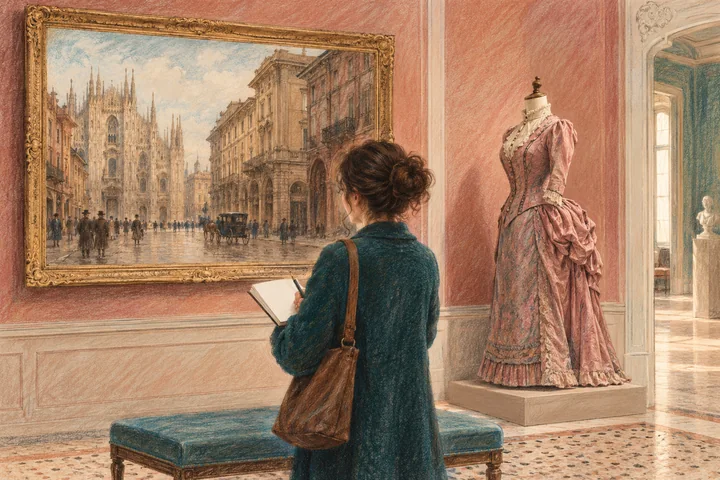
In a nineteenth-century room, try looking before reading the wall label. Where does the eye enter the picture? Is the most important figure the largest, the brightest or simply the one everyone else faces? A landscape can be approached in the same way: follow a road, the edge of a shadow or the division between foreground and distance. You are not testing your knowledge of names. You are noticing how a painted surface directs attention.
Read the label afterwards and see what changes. A date or commission can make your first interpretation more precise without making it foolish. Our guide to visiting the Pinacoteca di Brera develops a similarly selective approach. It is often more satisfying to remember three pictures clearly than to recognise thirty titles in a blur. Leave a little silence between works; a museum visit does not need an uninterrupted commentary.
Change the question for twentieth-century art
When the visual language changes, allow your questions to change too. Instead of searching immediately for a recognisable scene, ask how a surface has been made, how colours meet or how the work relates to your body at a particular distance. Walk only where the gallery permits and keep a respectful distance from objects. A quiet comparison between two works can be more useful than a hurried attempt to classify an entire movement.
For another Milan collection with a different setting, consider the Museo del Novecento. These institutions need separate visit planning; a shared century does not make their tickets or collections interchangeable. If your wider journey includes Turin, its GAM offers another opportunity to compare how a museum arranges modern art. Let the comparison develop from the works you actually see, rather than assuming the same artists or loans will be present.
Notice the room without losing the art
The Gallerie occupy three historic buildings, so changes of scale, light and circulation form part of the experience. Pause at a threshold and ask how the next room prepares you to look. Is a picture framed by an opening? Does a long view encourage you to hurry towards a distant work? These are observations about your visit, not evidence that every visible finish belongs to the building’s earliest phase.
The Caveau introduces another useful distinction: a collection’s storage and its public display are related but not identical. Check the current access arrangements rather than treating the word as a standing invitation to enter every storage area. Milan’s Poldi Pezzoli Armoury is a further reminder that display design can strongly shape what an object seems to say. The architecture is worth noticing, but it should not drown out the objects.
End with enough energy to remember
Choose a final work, make a short note and stop before attention becomes exhaustion. A museum shop or a nearby coffee can help you settle what you have seen, but neither is compulsory. If you are comparing guided options, our Milan arts and events collection can help you read the actual inclusions. Check the named museum, meeting point and admission terms; a general city walk does not automatically include this visit. A focused route leaves both a satisfying afternoon and a reason to return.
Sources & further reading
Turn a good read into a great day.
Find a highly rated Milanese experience that brings these stories to life.
Explore related experiences →