Milan’s Fondazione Luigi Rovati: how do ancient and contemporary works meet?

At the Fondazione Luigi Rovati in Milan, an ancient object and a contemporary work can become neighbours. The interesting question is not which one wins your attention. It is what happens when you look from one to the other. A curve, a material or a human gesture may suddenly seem familiar across a great distance in time. Familiarity, however, is the beginning of a question rather than proof of a historical connection.
The Art Museum is at Corso Venezia 52. Plan it as a collection visit in its own right, with enough time for a few comparisons and some quiet looking. Our Milan Archaeological Museum guide provides a useful contrast: these are different institutions with different collections, so check the name when choosing tickets and a route.
Understand the display’s organising idea
The Foundation’s collection introduction describes a dialogue between ancient, particularly Etruscan and Italic, objects and modern or contemporary art. The arrangement explores themes rather than requiring a single chronological march. That does not remove chronology from the objects. Keep dates and origins in view while following the relationships proposed by the display.
Start with a pair of works near one another. Without reading first, note their silhouettes, scale and texture. Then read both labels. Does the information strengthen your first comparison or reveal how different their purposes were? Either result is useful. The aim is not to discover that people have always made the same things, but to notice how similar forms can belong to very different worlds.
Give archaeological objects their own histories
The archaeological collection page explains that the holdings grew through several collections and later acquisitions. It identifies themes including religion, banquets, writing and relationships with nature. Those categories help you choose a manageable route through unfamiliar material. Select one theme that interests you instead of trying to master a civilisation in a single visit.
Read provenance and collection history where supplied. An object’s date, place of manufacture, find context and later ownership answer different questions. If a label does not establish a precise archaeological context, do not invent one from the decoration. A vessel can be beautiful and informative while some parts of its journey remain uncertain. Acknowledging that uncertainty usually makes the surviving evidence more interesting.
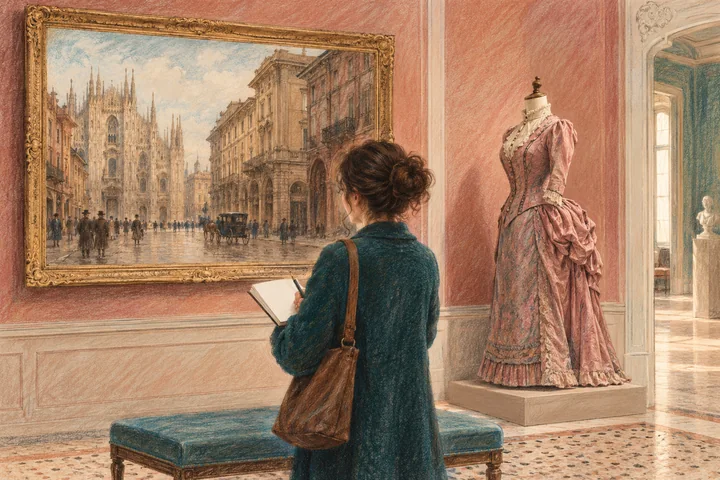
Try drawing the outline of one permitted object in a small notebook, if that suits you. The act of drawing forces attention onto the relationship between rim, body and base. Artistic talent is optional; a slightly wonky sketch can be a very good record of looking. Observe the museum’s rules about materials and keep clear of circulation routes and other visitors.
Keep comparison separate from influence
A modern artist may respond directly to antiquity, but you need the work’s interpretation to establish that relationship. Resemblance alone is not enough. Ask whether the museum proposes a visual comparison, documents an artistic influence or connects the objects through a shared subject. These are different kinds of argument, and learning to recognise them adds pleasure to many museums.
For another form of comparison, our Museo del Novecento guide focuses on a more concentrated period of art. Our HangarBicocca guide considers the space around large contemporary works. If you later visit Venice, starting with one object at the Oriental Art Museum offers another patient method without collapsing distinct cultures into one story.
Use current visitor information for the actual day
The official visit page checked on 21 October 2026 lists Wednesday–Sunday, 10:00–19:00, with last entry at 18:00 and Monday–Tuesday closure. Admission includes the permanent collection and temporary exhibitions. Check what is actually current: an attractive past exhibition page does not mean its loans remain on view. Groups must reserve according to the museum’s instructions.
The same page states that an accessible lift serves all floors and describes facilities and visitor support. Ask about your particular needs before travelling rather than interpreting a broad accessibility statement as a promise about every experience. The Milan experiences collection helps organise the rest of the trip; it does not imply that every city tour enters this museum. Finish with one comparison you can explain in your own words, and leave some questions open for next time.
Sources & further reading
Turn a good read into a great day.
Find a highly rated Milanese experience that brings these stories to life.
Explore related experiences →