Milan’s CityLife: what can you discover through its public art?

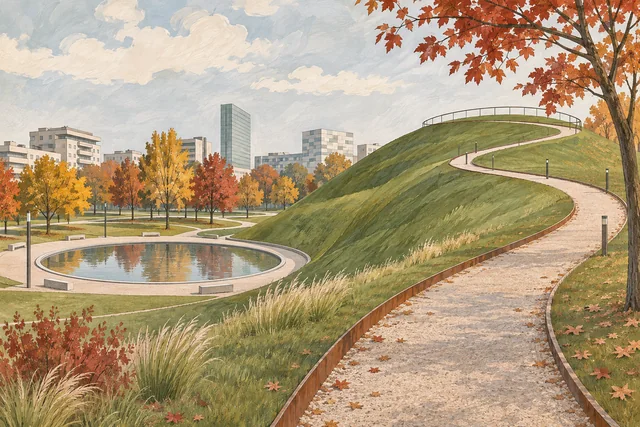
CityLife is an invitation to look at Milan at two different scales. The towers pull your gaze upwards; the park asks you to slow down at ground level, where paths, planting and public art meet everyday neighbourhood life. You do not need access to an office lobby or a rooftop to make a rewarding visit. Choose a short route through the public spaces and let a few works, rather than an architectural checklist, organise your attention.
What is ArtLine doing in the park?
The Ministry of Culture describes ArtLine Milano as a free public collection within CityLife's park. The works were conceived for this setting, in relation to its green spaces, architecture and residents. That makes their position part of the experience. A sculpture encountered beside a path has a different relationship with its audience from an object placed in a quiet gallery with a carefully controlled approach.
Try looking before reading the explanation. Notice what the work does to your movement: does it make you pause, circle around, look upwards or pay attention to something underfoot? Then read the artist and title. Your first response need not match the interpretation supplied by a label, but the label can introduce information that the shape alone cannot establish. Keep observation and interpretation in conversation rather than treating either as a test with one correct answer.
Can two stones hold your attention?
CityLife's guide to the ArtLine works identifies Wilfredo Prieto's Beso as two stones meeting at a single point. The title, meaning a kiss, gives that small contact an emotional suggestion. You can begin with a very ordinary question: what changes when two separate things touch? Look from more than one public position, without climbing on the work or entering planted ground. The changing silhouette may be enough to make the point of contact feel surprisingly expressive.
This is a useful exercise for children as well as adults. Ask each person to choose a word for the relationship between the forms, then explain which visible detail prompted it. Nobody needs to invent an artist's intention. The aim is to practise making an observation and supporting it. A park bench afterwards can become a better discussion space than a hurried photograph taken while everyone else walks on.
What else rewards a closer look?
The same official guide describes Ornaghi and Prestinari's Filemone e Bauci as two neighbouring columns, linked to the classical story of a couple wishing to remain together. Compare that pairing with Prieto's stones: similar questions about proximity can emerge from very different materials and forms. The comparison is an editorial suggestion for looking, not a claim that the artists intended the works as a matched pair.
CityLife also includes artworks with enclosed, underground or interactive elements. An artistic description of a room does not establish that visitors may enter it at any moment. Follow the current signs and any managed access arrangements. Public park access should never be expanded into an assumed right to enter every structure, climb a sculpture or investigate a doorway. The same care applies to the towers, whose interiors have their own uses and access rules.
How do you keep the walk manageable?
Start with two or three works and an uncomplicated return route. Check the official project information against the actual paths available that day, especially around maintenance or temporary activity. A person using a wheelchair or travelling with a pushchair will need the precise entrance and surface information, not simply the reassurance that the destination is a park. Leave room to shorten the visit if the weather or the group's energy changes.
For another example of deliberately shaped ground, our Parco Portello guide explores a separate Milan landscape. It can be interesting to compare the way each place directs movement, but they need not be joined into one long outing. Likewise, the Brera Botanical Garden encourages attention to plants on a different scale. Choose the setting that suits the day rather than treating all green spaces as interchangeable.
Where does the skyline fit into the experience?
Pause far enough from a tower to notice how its outline relates to the space around it, then look back at the human scale of a seat, a path junction or a planting bed. Avoid evaluating the district only through its tallest objects. The question of how people use a designed environment connects naturally with our ADI Design Museum guide, although that museum is a separate destination with its own visiting arrangements.
If your wider trip includes Turin, its PAV guide considers another relationship between contemporary art and a living environment. It is a comparison of questions, not a suggestion that the two institutions share a programme or admission. Browse our Milan walking experiences for guided options and check the actual route before booking. CityLife offers enough interest at ground level to reward an unhurried public-space visit, with the skyline as a companion rather than the whole story.
Sources & further reading
Turn a good read into a great day.
Find a highly rated Milanese experience that brings these stories to life.
Explore related experiences →