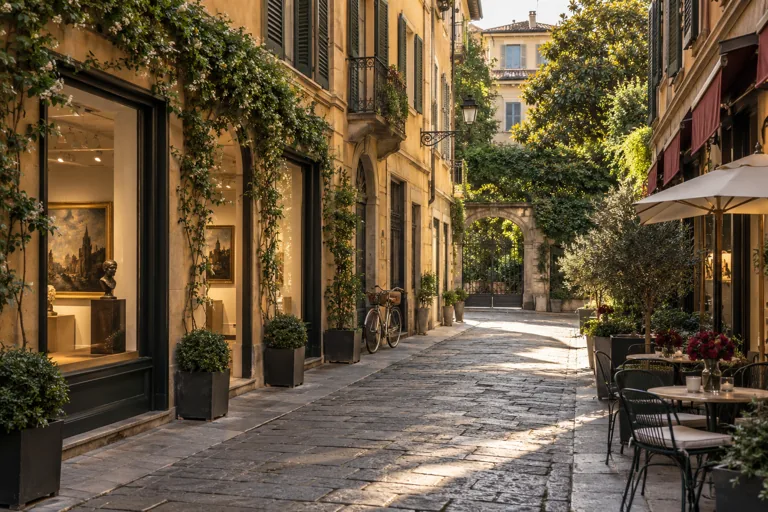
Milan’s Brera Botanical Garden: what changes when you look beyond the flowers?

A botanical garden does not stop being interesting when the flowers retreat. At Milan’s Brera Botanical Garden, a useful visit can begin with the shape of a leaf, the arrangement of branches or the words on a plant label. Thinking in terms of a living collection changes the pace: you are looking at organisms in a particular season, not judging whether a decorative scene has arrived on schedule.
What makes this a botanical garden?
The University of Milan’s account places the garden’s foundation in 1774–1775, within Maria Theresa’s programme of educational reform, and records the University’s management from 1935. This background helps explain why labels and organised plant collections matter as much as an attractive view. You do not need specialist knowledge to begin. The useful habit is to notice something carefully, then ask what the garden’s own information adds.
Start with one plant you can see clearly from the path. Compare the outline of its leaves with a neighbour’s, then look at the spacing along a stem. Read the label afterwards. A botanical name can help you keep track of the observation without requiring you to learn a whole vocabulary in a morning. If a label is absent or unreadable, leave the identification open; a confident guess is less useful than a well-described question.
How can autumn make the visit richer?
Choose a small area and notice three different kinds of change. Perhaps one plant carries leaves while another exposes its branching structure; perhaps a seed-bearing part is easier to see than a flower. What is actually present will depend on the day, weather and individual plant. No autumn colour chart can promise that a particular tree will look a particular way when you arrive.
You might make a short observational note: shape, colour, position. Avoid turning every yellow leaf into a diagnosis or every bare branch into a sign of poor care. The point is to practise looking, not to issue a plant-health report. Stay on the permitted route and leave fallen material where it lies. A drawing or photograph, where allowed, keeps the memory without removing part of the collection.
This approach fits naturally with a slow walk through Brera. It can also make the transition to the Pinacoteca di Brera more interesting: after watching real leaves and changing light, you may notice painted vegetation differently. The garden and gallery have separate visiting arrangements. Their shared neighbourhood does not turn admission to one into access to the other.
When can you actually enter?
The official visiting page gives regular opening on non-holiday Mondays to Saturdays, with seasonal hours. Check the University’s current notices before travelling. At our review on 25 October 2026, a technical closure had been announced for 24 October, and winter hours were due to begin on 2 November. Sunday 25 October is outside the normal Monday–Saturday schedule. A recent photograph of an open gate is not a reliable opening calendar.
For planning, the normal warm-season period is 10:00–18:00 and the winter period 09:30–16:30; follow the current dated notice when changing between them. Allow for a closure or restricted route without making the whole day depend on one entrance. The garden’s FAQ confirms free entry and explains visitor rules, including restrictions on picnics and collecting plant material. Groups should check the arrangements that apply to them.
What should you consider about the route?
The official information identifies entrances from Via Brera and Via Fratelli Gabba, with ramp access at the latter. Gravel and other surface conditions still matter. If step-free travel, a mobility aid or a particular resting requirement is important, ask about the route you will actually use rather than treating an accessible entrance as a description of every metre inside. Wet weather can change how a short outdoor visit feels.
Keep your plan compact. One careful circuit and a few memorable observations may be more satisfying than chasing every labelled plant. If you want a broader open-air pause on another part of the day, Parco Sempione offers a different kind of public green space. A botanical collection and a large urban park reward different expectations, even when both provide welcome breathing room.
For travellers continuing towards the lake, the Como Silk Museum provides a thoughtful change of subject from living organisms to material production; it is a separate visit in Como, not an extension of the garden. To add a guided city route, compare our Milan walking experiences, checking meeting points and actual inclusions. The garden’s quiet pleasure needs little embellishment: arrive when it is open, look closely, and let the season supply the details.
Sources & further reading
Turn a good read into a great day.
Find a highly rated Milanese experience that brings these stories to life.
Explore related experiences →