Looking up in Milan’s Galleria: glass, iron and urban theatre
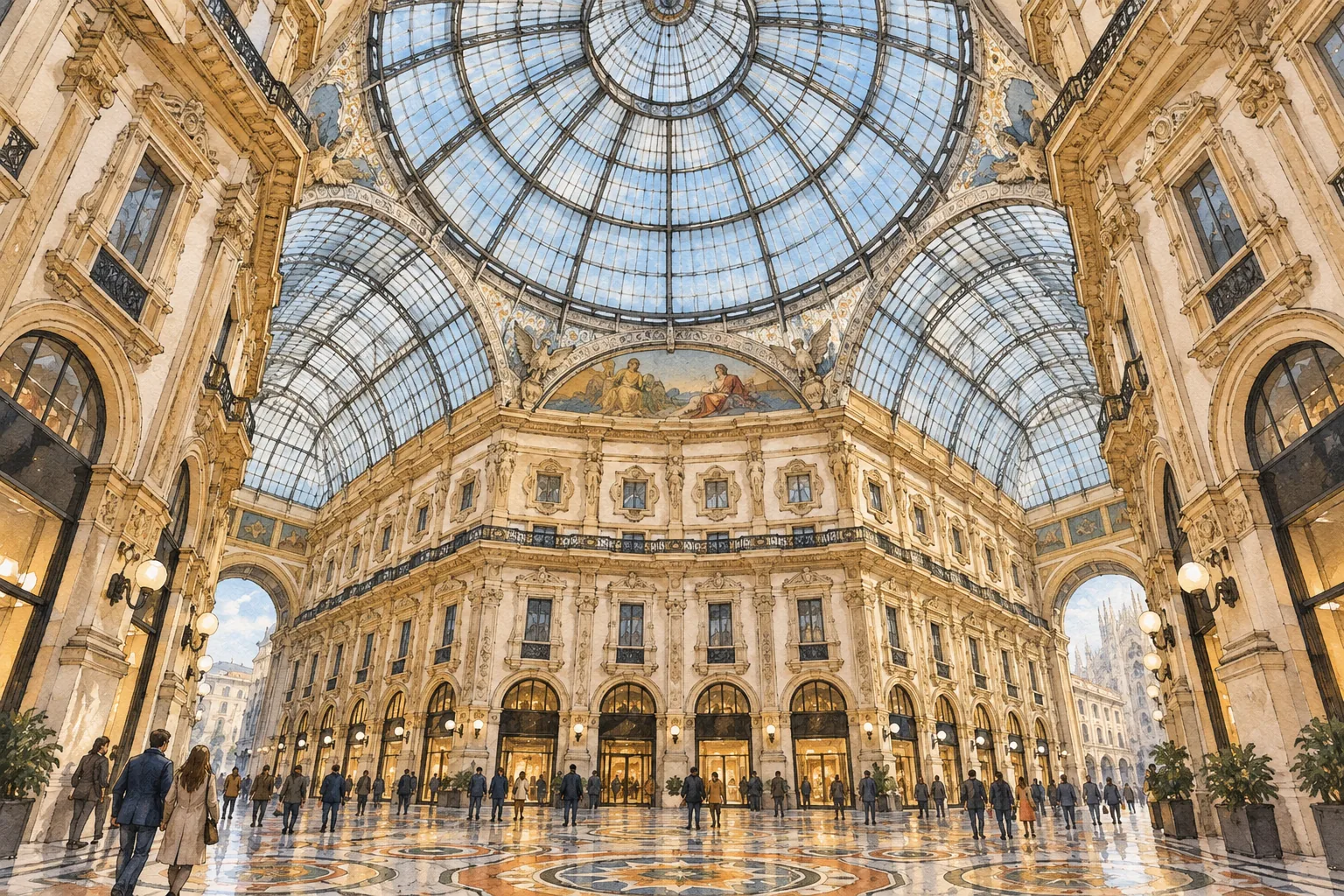
Milan's Galleria Vittorio Emanuele II can be visited as a shopping passage, a route between landmarks or a place to meet. For a few minutes, try treating it primarily as a roof over a piece of city. Looking upward changes the experience: shopfronts become part of a larger architectural rhythm, and the crowd below becomes a moving measure of the building's scale.
Find a safe place to stop before looking up. The Galleria remains a busy passage, and the best architectural appreciation does not involve walking backward into someone else's lunch. Our Galleria-to-Brera walk places it within a longer route; this article stays inside long enough to ask what gives the space its character.
Place it in nineteenth-century Milan
The Italian Ministry of Culture's architectural record attributes the design to Giuseppe Mengoni and dates the complex's construction to the period from 1865 to 1877. It belongs to a very different moment from the medieval beginnings of the nearby cathedral, even though the two now feel inseparable in the visitor's image of central Milan.
Lombardy's cultural-heritage account presents archival images and designs connected with the project, including the laying of the first stone in 1865. Such records remind us that the Galleria was planned and constructed through decisions and work. It did not simply appear as a ready-made symbol of elegance.
Follow the roof's structural rhythm
Look along one of the covered passages, then toward the central dome. The repeated metal elements and panes of glass make it possible to read both enclosure and light at once. The roof marks an interior, yet the changing sky remains part of what you see. Watch how a brighter patch above changes your impression of the surfaces below.
You do not need to identify every structural member. Try tracing a repeated line with your eye and noticing where it meets another system of lines. Then lower your gaze to the facades. The contrast between the lighter-looking roof and the more solid architectural edges helps make the passage feel both grand and open. That is a visual reading, not a substitute for an engineering survey.
Notice how repetition organizes variety
At street level, entrances, displays and people produce constant changes. Above them, repeated windows, decorative bands and building heights pull the view together. Choose one bay and compare it with the next. Which features repeat, and where does an entrance, corner or central space interrupt the sequence?
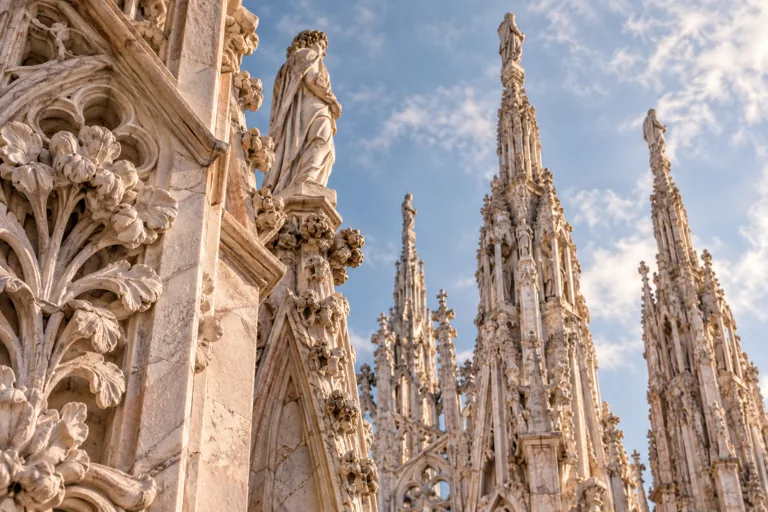
Our guide to reading the Duomo offers a contrasting exercise in looking at architectural detail. Resist ranking one building as more “authentic” because it is older. Each asks different questions about materials, labor, public ambition and the relationship between a monument and everyday life.
Read the passage as a connection
YesMilano's official one-day itinerary connects the cathedral area, the Galleria and La Scala. Walking through the covered space therefore changes more than your immediate surroundings: it takes you between different kinds of civic landmark. Notice the transition from open square to enclosed passage and back to daylight.
At the La Scala end, decide whether the theatre is simply the next exterior view or a separately planned visit. Our La Scala museum-or-performance guide keeps those choices clear. A famous building on your route does not automatically require an admission, especially when the walk itself is your main interest.
See conservation as part of the architecture
Iron and glass need continuing care. In December 2025, the municipality approved a roof-conservation project addressing metalwork, glazing and rainwater drainage. Its account identifies the supports of the dome's eight principal arches among the areas requiring attention. That makes the roof interesting as a maintained structure, not just an elegant silhouette.
The announcement describes a proposed phased approach intended to preserve use of the passage and access to businesses. It is a project approval, not proof that every stage is already complete. Check current local notices and respect any temporary barriers during your visit. Scaffolding or protective work, if present, is part of the monument's continuing care rather than evidence that the city has failed to preserve a perfect frozen moment.
After looking upward, notice the floor's patterns and the passage's everyday users: people crossing to work, meeting friends and stopping for a meal. The structure has to accommodate that ordinary life while being conserved. That practical challenge is an additional reason to appreciate the roof above you.
Choose an explanation that matches your curiosity
Compare Milan walking experiences if you want a guide to connect the building with the surrounding city. Read the itinerary to see how much attention the Galleria receives and whether any paid interiors are included. For an independent visit, one question and ten attentive minutes can already make the passage feel different.
On another city day, Bologna's porticoes provide an interesting comparison: covered movement can take the form of a monumental enclosed passage or a continuing street edge. Notice the differences in light, rhythm and ordinary use. Architecture becomes easier to remember when you connect its beauty with the simple act of moving through it.
Sources & further reading
Turn a good read into a great day.
Find a highly rated Milanese experience that brings these stories to life.
Explore related experiences →